 Rediscovering Biblical Friendships in an Age of Individualism
Overview
Category
Rediscovering Biblical Friendships in an Age of Individualism
 Why Churches Struggle to Reach Culture: The Untold Reason
 The Character of God: How We Miss His Heart with Rule-Keeping
7 min read
The Downfall of Religious Pluralism
Overview
In the past decade we have watched news shift from the pessimism of a decline in religion in America, to the optimism of the openness of young people to spirituality. There is no question young people are spiritually open. You can walk into any trendy coffee shop and overhear conversations about mindfulness, manifestation, crystals, Jesus, meditation retreats, personality tests, and Christ consciousness. It’s as if they are all puzzle pieces from the same box. Like the curation of a playlist, spirituality has become customizable with an aesthetic or mood. In some ways, this openness is refreshing. It shows how people are hungering for transcendence. The belief is there must be more to life than what we can see, measure, or post. There must be something more than this physical world, a guiding force behind the universe.
But as spiritually open our generation is, we struggle to land anywhere. Many wander from one idea to the next. We try what feels good in the moment only to switch it up when it’s no longer working or doesn’t fit our vibe. This is religious pluralism, that all beliefs are equally true or valid. With this wandering through ideas, contradictory beliefs are mixed and matched without much thought. And if this inconsistency is recognized, many feel they can’t bring it up because it’s deemed impolite to ask whether someone’s beliefs are actually true. Not to mention many think it’s wrong to force your truth upon someone else’s. They say what matters ultimately is that someone feels as if life is meaningful and they are authentic. There is a huge problem with this. Meaning and beauty and personal resonance, while important elements of spirituality, cannot do the job truth alone can. They can stir the heart and produce good feelings, but they cannot anchor the soul.
Truth is More Than a Feeling
Before we address religious pluralism, we need to talk about truth. Truth is not whatever inspires us, comforts us, or gives us a sense of belonging. Truth is not what feels authentic. Truth is that which corresponds with reality. If a claim describes the world as it actually is, its true. If it doesn’t, it’s false. We have no problem living like this when interacting with the physical world. For example no one stands at the top of a building and says “I can fly” while people below yell, “live your truth!” That would be insane. If there really is a spiritual realm as the spiritually open would say there is, then there must be a truth about that spiritual realm as well. This matters because different religions make radically different claims about what is real. Christianity says Jesus is God. Islam says he is not God and that God could never become human. Many eastern religions say God is not personal. Christianity says God is and exists eternally as Father, Son, and Holy Spirit. The list could go on.
The Law of Non-Contradiction
These claims can all be false, but they can’t all be true. I don’t say this because Christians are exclusive and bigoted and narrow-minded, I say this because truth by its very nature is narrow and exclusive. Reality does not bend to our personal preferences. The Law of Non-Contradiction says that two claims which directly oppose each other cannot both be true in the same way at the same time. Thus, Christianity and Islam cannot both be right in their claims about Jesus, and Eastern Religions and Christianity cannot both be right in their claims about who God is. Either someone is mistaken, or everyone is mistaken. But they cannot all be true.
Pluralism tries to treat every worldview as true, but once these worldviews start making claims about reality, the contradictions become unavoidable. In an attempt to be kind or inclusive, pluralism collapses under its own weight. In order to honor everyone’s preferences and be tolerant, it ends up emptying and hollowing out each religion and does not take their claims seriously.
The Map vs. Mood Problem
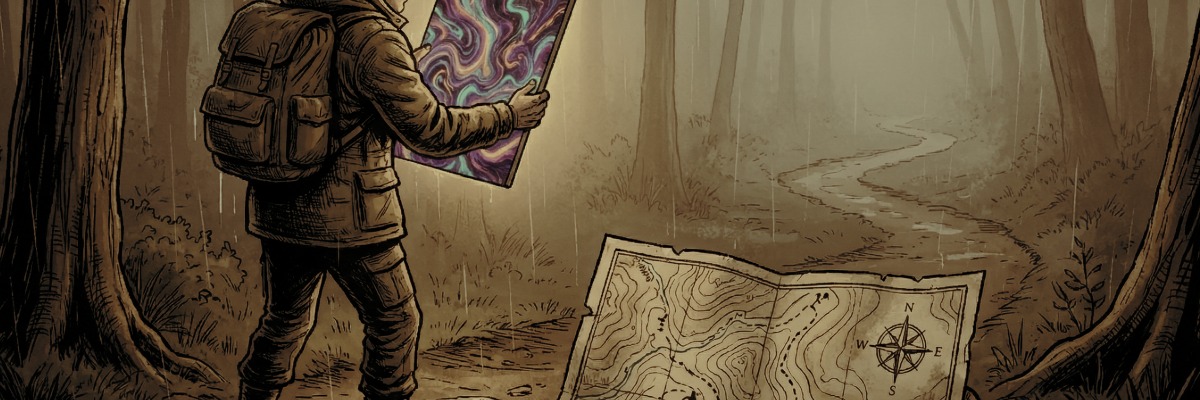
Here is one way to picture the problem. Imagine you are trying to get to a destination. It could be home, it could be a friend’s wedding, it could be your school. In attempting to find your way, you open two maps. One map looks beautiful. It’s colorful, pleasing to look at, and trendy. If you expanded it, it may even serve as an art piece to hang on your wall. The other map is plane and simple. The colors are dull, and the aesthetics are outdated. Which one should we trust? The map that corresponds to reality. While the first map is colorful and aesthetically pleasing, upon further investigation, you realize it’s wrong. It won’t get you to your destination. The second map, while it may not be as awe inspiring, is true. It depicts the roads as they are in reality.
In our culture moment, we often confuse beauty with truth. We choose the map that makes us feel something good in the moment, even if it leads us nowhere. We treat religions like inspirational artwork rather than a map that speaks to reality. They are thought of as something to admire, sample, and intertwine to create a vibrant canvas. But if your map is wrong, you still end up lost. Your map can be inspiring, but inaccurate at the same time. If your map stirs up your rich emotions but doesn’t match reality, your emotions won’t save you in the end. To say that all religions are true and we get to chart our own course is to say every map points to the right place. They don’t, they point in different directions, sometimes opposite ones.
The Real Reason Pluralism is So Attractive
Pluralism isn’t just a misunderstanding of what truth is and a refusal to take religious claims seriously. It is also a form of misplaced worship. Pluralism is attractive because it allows someone to feel spiritual without ever having to submit to any God who makes claims on our lives. It gives the benefits of spirituality without the cost of obedience. If we remain open, we remain autonomous. If we are always open to new ideas and never say this is right and this is wrong, we never have to call someone else’s views mistaken. The moment we recognize what is true, the moment truth begins to impact us and shape us, and call us to live in alignment with it.
I wonder if many people who are spiritually open are really looking for God, or are simply looking for an experience which allows them to stay in control. Collecting different spiritual ideas and borrowing from different regions can feel creative and respectful to various practices, but it won’t lead you towards the truth.
Here is the reality, when we refuse to worship the one true God, we don’t stop worshiping. We simply turn our worship inward. We worship a personal spirituality designed around our preferences. We make a god in our own image who never contradicts us or pushes us too hard. We find a god who never asks us to repent or never asks us to submit. Pluralism isn’t broad; it’s actually really shallow. Its spirituality without surrender and openness without direction. Ultimately its a belief in something false, and that had devastating consequences. It is a lie that is ruining lives.
Landing Somewhere Real
Openness and curiosity are good things. Asking questions is a good thing. Exploring other ideas is a good thing. The Christian story welcomes seekers. It’s knowable and based on reason and evidence. Jesus never rebuked someone for asking honest questions. But openness is only virtuous if it leads to truth. If we remain open forever and never commit or never land, we confuse the journey for the destination. We confuse what may feel inspiring in the moment with what is true in the end.
The point of openness and curiosity is to find what is real and true. And truth beacons us to respond. At some point, we all must decide which map corresponds with what is true. We must decide which voice to follow. Pluralism invites us to admire every map. Jesus invites us to walk the one that leads us home.
Category